
From Luddites to AI: Why Every Technological Wave Feels Scary
AI isn’t the first innovation to trigger fear, skepticism, and resistance. The Luddite movement reminds us that society has always struggled to manage technological change — yet progress continues, especially when guided by responsibility, ethics, and optimism.
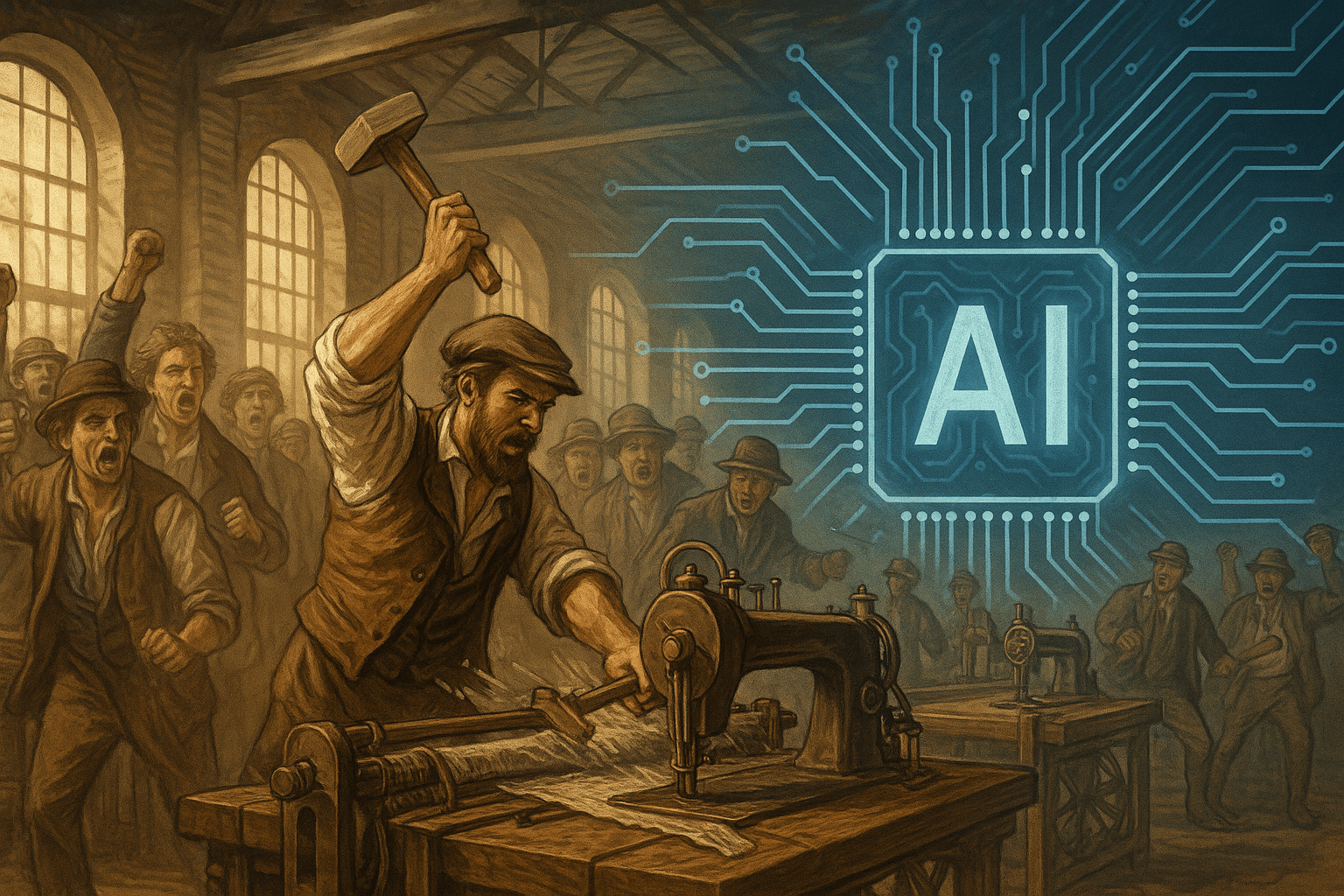
Every new technology feels like a threat at first, until it becomes something ordinary, useful, even empowering.
The First Wave of Tech Anxiety: The Luddites
In early 19th-century England, textile workers destroyed machines they believed would replace them.
That fear wasn't irrational, it came from uncertainty, loss of control, and rapid change.
Today, we’re seeing a similar emotional pattern around AI.
Hope and Fear Always Travel Together
Optimism loves talking about productivity, creativity, medicine, accessibility, and education.
Pessimism warns about job displacement, misinformation, inequality, and unpredictable consequences.
Both sides exist because the future isn't fixed, we are still shaping it.
The Real Risks Aren’t Science Fiction
AI models learn from human data, and humans come with biases, cultural blind spots, stereotypes, and power dynamics.
So without transparency and scrutiny, automated decisions can quietly reproduce discrimination.
Add facial recognition, pervasive cameras, data harvesting, and surveillance capitalism,
and you understand why privacy laws like GDPR and the upcoming AI Act exist.
Regulation isn't just bureaucracy, it's a collective safety belt.
Governance Without Doom
Science-fiction warned us long before engineers did.
Asimov imagined his famous Three Laws of Robotics not as predictions,
but as a reminder that intelligent systems must protect humans first.
We’re nowhere near AGI or superintelligence, but thoughtful guardrails now
help prevent future mistakes.
When the Stakes Are Human Lives
Legal decisions, hiring, healthcare, policing,
these aren't places where algorithms should have the final word.
AI can support professionals, analyze patterns, speed up workflows,
but accountability must remain human.
At least for now.
A Balanced Way Forward
What history teaches is simple:
- fear is normal
- rejection rarely works
- unregulated acceleration is dangerous
- responsible optimism builds progress
The goal isn't blind enthusiasm or paralyzing panic,
it's constructive awareness.
Choosing the Better Story
Every technological revolution creates turbulence.
But we also invent, adapt, course-correct, and improve.
If we combine creativity, ethics, transparency, and curiosity,
AI can become another tool that expands human potential, not replaces it.
The future isn’t written by machines.
It’s written by the people who choose how to use them.
Extended Bibliography & Thinkers
-
Isaac Asimov — I, Robot (1950) Fictional framework that sparked ethical reflection on human–machine interaction.
-
Joseph Weizenbaum — Computer Power and Human Reason (1976) Early warning on automation without moral responsibility.
-
Neil Postman — Technopoly: The Surrender of Culture to Technology (1992) Cultural critique of technological dependence.
→ penguinrandomhouse.com -
Donna Haraway — A Cyborg Manifesto (1985) Provocative perspective on identity, power, and hybrid humans.
→ warwick.ac.uk -
Nick Bostrom — Superintelligence (2014) Philosophical investigation into AGI risk and long-term futures.
→ nickbostrom.com -
Shoshana Zuboff — The Age of Surveillance Capitalism (2019) How data-driven business models extract behavioral value.
→ shoshanazuboff.com -
Cathy O’Neil — Weapons of Math Destruction (2016) Algorithms that reinforce inequality and injustice.
→ weaponsofmathdestructionbook.com -
Luciano Floridi — The Ethics of Information (2013) Foundational text on digital responsibility and moral agency.
→ philosophyofinformation.net -
Tim Wu — The Attention Merchants (2016) How technology economies compete for human focus.
→ penguinrandomhouse.com -
Evgeny Morozov — To Save Everything, Click Here (2013) Critique of solutionism, when tech becomes ideology.
→ themorozov.com
Technology doesn't just change tools, it changes values, power, identity, work, and imagination.
These authors remind us to innovate with awareness, curiosity, and responsibility.