
Interpreting Your Ikigai: Making Sense of Your Results
Your Ikigai results aren't a verdict, they're a mirror. Learn how to read them, reflect on what's missing, and take your next step with clarity.
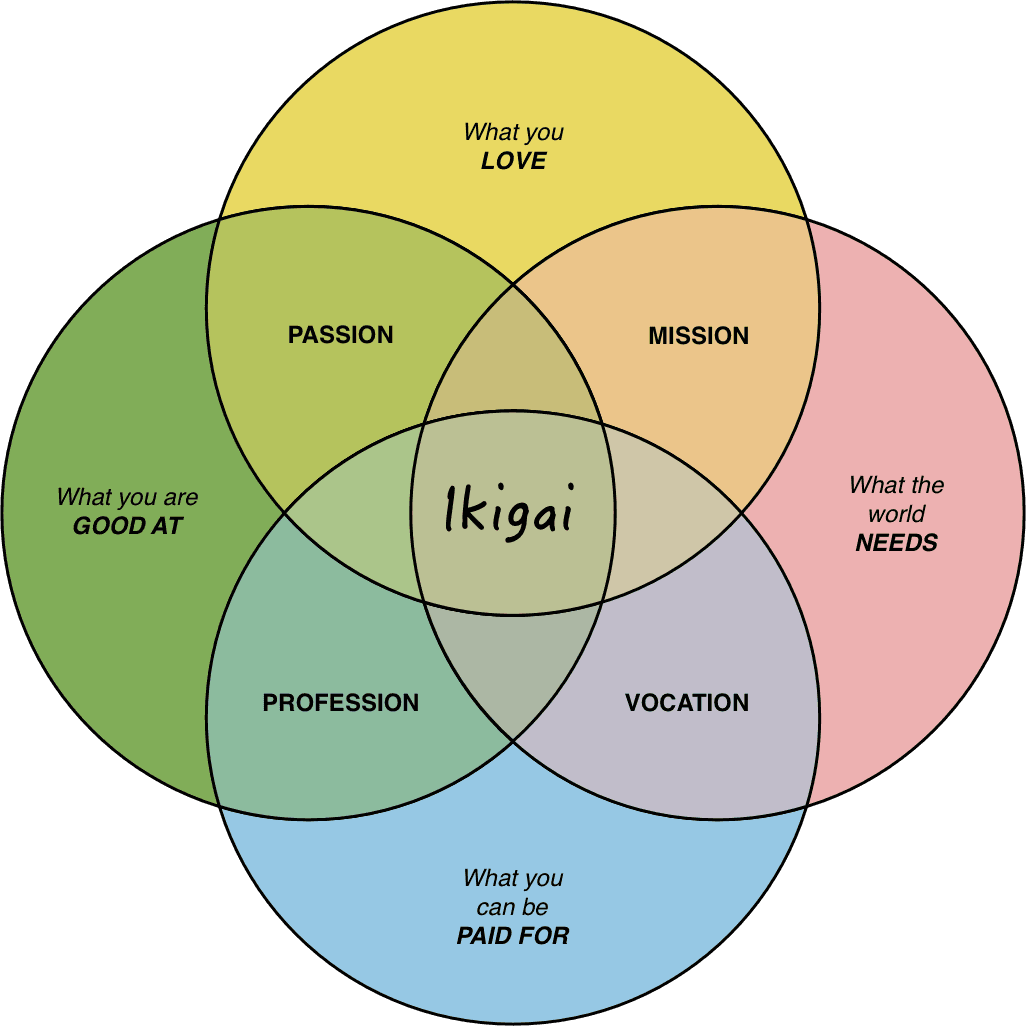
Your Ikigai results aren’t meant to define you, they’re meant to reveal you.
What you see in them depends on how honestly you look.
Understanding Your Ikigai Map
Ikigai (生き甲斐) is profoundly personal. No algorithm or survey can give it to you, but a good reflection can help you see it more clearly.
Your Ikigai lies at the intersection of four elements:
- What you love
- What you’re good at
- What the world needs
- What you can be paid for
When these four spheres overlap, you reach the center: your Ikigai, your reason for being.
But most of us live somewhere around that center, not perfectly in it.
That’s perfectly okay. The map is not a judgment, it’s an invitation.
The Four Core Areas
Each of the four areas represents a key dimension of fulfillment:
- What you love: passion, curiosity, intrinsic motivation
- What you’re good at: skill, mastery, confidence
- What the world needs: purpose, contribution, impact
- What you can be paid for: sustainability, stability, autonomy
When one area dominates the others, we often feel imbalance.
That’s the quiet signal your results are trying to show you.
The First Layer of Interpretation
If your results are higher in some spheres and lower in others, you might find yourself in one of these four “quadrants”:
Profession
You’re doing something you’re good at and paid for, but maybe it doesn’t feel meaningful or inspiring.
You might sense efficiency without fulfillment.
Vocation
You’re paid to do something useful to others, but it doesn’t ignite your curiosity or play to your strengths.
This can lead to fatigue or emotional distance.
Mission
You’re doing something you love and find meaningful, but it’s not yet financially or practically sustainable.
You might feel inspired but insecure.
Passion
You’re doing what you love and are good at, but you’re missing contribution or recognition.
You might feel joy but also a quiet sense of emptiness.
Recognizing where you stand isn’t limiting, it’s empowering.
You can’t move toward your Ikigai without first knowing your starting point.
When Three Spheres Align
Sometimes three spheres overlap while one remains outside.
Here’s what that often means:
- Love + Skill + Need (no pay) → deeply meaningful but not sustainable long-term.
- Love + Skill + Pay (no need) → satisfying but lacks a sense of contribution.
- Skill + Pay + Need (no love) → efficient but emotionally empty.
- Love + Need + Pay (no skill) → meaningful but exhausting; you’re forcing mastery.
Each configuration has both gifts and gaps.
The map helps you see which energy you might be missing, passion, mastery, contribution, or stability.
How to Work with Your Results
The goal isn’t to “fix” your chart but to use it as a compass.
- Reflect: What part of your life feels most alive? Which feels stale or draining?
- Accept: It’s fine to be out of balance. Awareness is the first correction.
- Adjust: Choose one small step to nurture a weaker sphere.
- Reconnect: Purpose grows through relationships. Talk about what you’ve discovered.
- Repeat: Your Ikigai evolves, treat it as a living map.
A Realistic Perspective
You don’t need your job to fulfill all four spheres.
If your work covers love, skill, and pay but not contribution, you can balance it elsewhere, through volunteering, mentoring, kindness, or creative projects.
Ikigai isn’t perfection. It’s harmony.
A Personal Note
The Ikigai test doesn’t give you answers, it gives you questions.
It’s an act of awareness, not achievement.
When you see your results, resist the urge to judge them.
Instead, ask: What story are they telling me about what I value, what I ignore, and what I could nurture next?
That’s where the work begins.
“Even if you never reach the end of the path, it doesn’t matter, tonight you are both the runner and the finish line.”
, David Gossman